Temporary emails aren’t GDPR-free zones. They can process personal data just like regular inboxes, triggering compliance obligations. But with smart practices—like avoiding sensitive info and using GDPR-aware services—you can safely use them for signups, testing, and low-risk activities without breaking the law.
Key Takeaways
- Temporary emails can be personal data: If linked to an individual (e.g., via signup forms), they fall under GDPR, requiring lawful processing.
- Legitimate interest isn’t a free pass: You must balance your need for a temp email against the user’s privacy rights—never for sensitive data.
- Deletion isn’t enough: GDPR requires proper handling during the email’s brief lifespan, including security and purpose limitation.
- Choose GDPR-compliant providers: Avoid services storing data in non-EU servers or lacking clear privacy policies.
- Never use for high-risk activities: Skip temp emails for financial logins, health data, or anything requiring long-term identity verification.
- Document your reasoning: If relying on legitimate interest, record why the temp email use is necessary and proportionate.
- User awareness matters: Clearly state if you’re using a temp email service in your privacy policy to maintain transparency.
📑 Table of Contents
- Why Temporary Emails Feel Like a GDPR Loophole (But Aren’t)
- When Temporary Emails Trigger GDPR Obligations (It’s More Common Than You Think)
- The 3-Step Framework for GDPR-Compliant Temporary Email Use
- Common GDPR Pitfalls with Temporary Emails (And How to Avoid Them)
- When Temporary Emails Are a GDPR Non-Starter (Avoid These Cases)
- The Future of Temporary Emails and GDPR: Trends to Watch
- Conclusion: Temporary Emails Can Be GDPR-Compliant—If You Play Smart
Why Temporary Emails Feel Like a GDPR Loophole (But Aren’t)
Let’s be real: temporary email services are magic for dodging spam. Need to sign up for a one-time webinar? Grab a 10-minute inbox. Testing a new app? Use a burner address. They promise anonymity, convenience, and zero commitment. It’s no wonder they’re popular with developers, marketers, and everyday users trying to keep their main inbox clean.
But here’s the catch: GDPR doesn’t care if your email vanishes in 60 minutes. If that temporary address processes any information linked to a real person—like their name, IP address, or even the fact they signed up for your service—it becomes “personal data” under GDPR. Suddenly, that disposable inbox isn’t so disposable from a compliance perspective. The moment you use a temp email to interact with EU residents, GDPR applies. Ignoring this is like thinking a pop-up shop isn’t subject to health codes because it’s temporary. Spoiler: It is.
The GDPR Reality Check: It’s Not About the Email’s Lifespan
GDPR focuses on how personal data is processed, not how long the container exists. Article 4(1) defines personal data broadly: any info relating to an identifiable person. If someone uses a temp email to create an account on your EU-facing website, that email address—however short-lived—is now personal data. You’re processing it. You have obligations. The 10-minute expiry doesn’t erase the fact that data was collected, stored (even briefly), and potentially exposed.
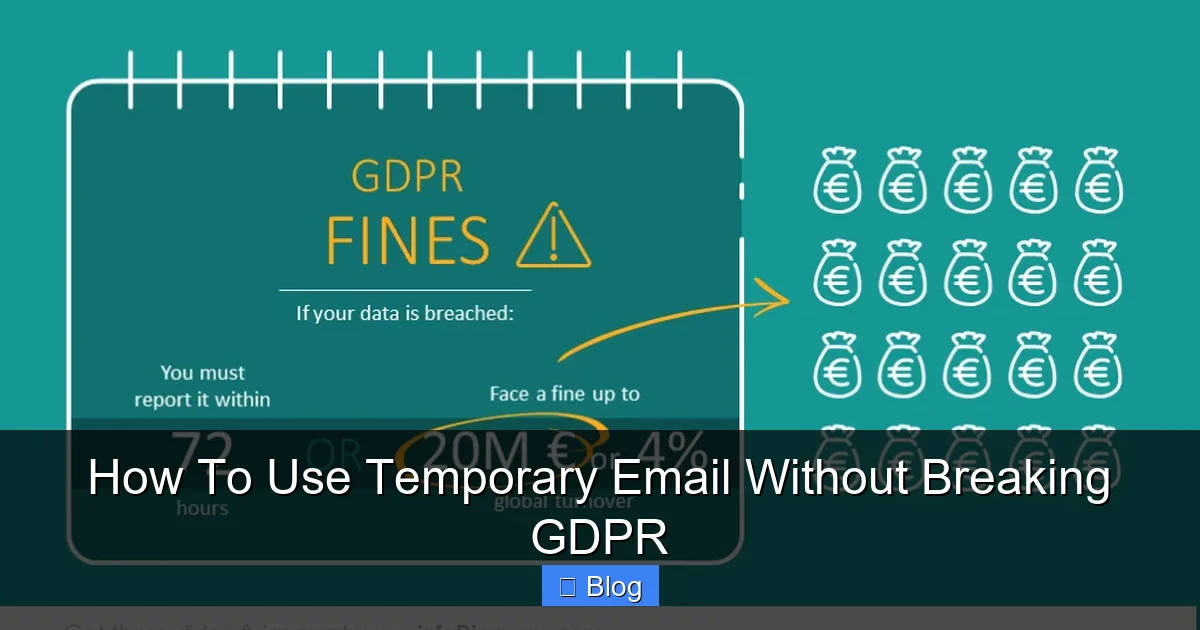
Think of it like a hotel room key. Just because you check out in an hour doesn’t mean the hotel can ignore fire safety rules during your stay. Similarly, temp email providers and users must follow GDPR principles while the email exists. This includes lawfulness, purpose limitation, data minimization, accuracy, storage limitation, integrity, and accountability. Skipping these because “it’s temporary” is a fast track to fines—up to 4% of global revenue.
When Temporary Emails Trigger GDPR Obligations (It’s More Common Than You Think)
Many assume temp emails only matter for the user (the person signing up). But GDPR impacts both parties: the temp email service provider and the business or individual using the temp email to interact with others. Let’s break down the scenarios where compliance kicks in.
Visual guide about How To Use Temporary Email Without Breaking GDPR
Image source: cdn.infodiagram.com
Scenario 1: You’re the Business Using Temp Emails for Signups or Testing
This is the big one. Imagine you run an e-commerce site targeting EU customers. A user signs up for your newsletter using a temporary email from Mailinator or Guerrilla Mail. Congratulations—you’re now processing personal data (that email address). GDPR applies to you, the data controller.
- Lawful Basis Required: You need a valid reason to process that email. “Legitimate interest” (e.g., “we need this email to send the newsletter they requested”) is common, but you must prove it doesn’t override the user’s rights. Sending unsolicited marketing? That’s likely not legitimate.
- Purpose Limitation: You can only use that email for the purpose the user agreed to (e.g., the newsletter). Selling it? Big no-no.
- Data Minimization: Don’t collect extra data “just in case.” If the newsletter only needs an email, don’t ask for a birthdate.
- Security: Protect that temporary email address in your database like any other. A breach exposing temp emails still counts as a GDPR violation.
Real-World Example: A German SaaS company used temp emails for beta tester signups. They stored these emails in an unencrypted spreadsheet “for quick access.” When a hacker leaked the list, the company faced GDPR fines because they failed to implement appropriate security—even though the emails were temporary. The short lifespan didn’t excuse poor data handling.
Scenario 2: You’re the Temp Email Service Provider
If you run a service like 10MinuteMail or TempMail, GDPR applies to you as a data processor. You’re handling emails sent to those temporary addresses—which often contain personal data (e.g., “Hi [Name], your order #123 is shipped!”).
- You Must Have a Legal Basis: Typically, this is “contractual necessity” (you need to process emails to deliver the service users signed up for).
- Strict Data Retention: GDPR’s storage limitation principle means you must delete emails after the session ends. Keeping logs “for security” beyond the promised expiry? That’s a violation unless justified.
- Transparency: Your privacy policy must clearly explain what data you collect (IP addresses, email content), why, and how long you keep it. Vague policies won’t cut it.
- Security Measures: Emails in transit and at rest need encryption. If a temp email contains a password reset link, that’s high-risk data—you need robust protection.
Red Flag: Many free temp email services operate from non-EU servers (e.g., Russia, China) with murky data practices. Using them for EU user interactions? You’re likely violating GDPR’s international transfer rules unless they have EU Model Clauses or similar safeguards.
Scenario 3: You’re an Individual Using Temp Emails for Personal Tasks
Even as a solo user, GDPR can apply if you’re processing others’ data. Example: You use a temp email to sign up for a forum where you post messages containing colleagues’ names or project details. If those posts identify EU residents, you could be a data controller for that specific processing activity. While enforcement against individuals is rare, the risk exists—especially for freelancers or consultants handling client data.
The 3-Step Framework for GDPR-Compliant Temporary Email Use
Using temp emails without breaking GDPR isn’t about avoiding them entirely. It’s about using them responsibly. Follow this practical framework:
Step 1: Assess If You Really Need a Temporary Email (Data Minimization)
GDPR’s data minimization principle says: only collect what’s necessary. Before reaching for a temp email, ask:
- Is this interaction low-risk? Good candidates: one-time webinar signups, downloading a public whitepaper, testing a non-critical feature. Bad candidates: banking logins, healthcare portals, or anything handling sensitive data (health, financial, racial info).
- Could I use a dedicated alias instead? Services like Firefox Relay or SimpleLogin create permanent, forwardable aliases that mask your real email. They’re often more GDPR-friendly because they’re designed with privacy in mind (and many are EU-based).
- What’s the bare minimum data required? If a service only needs an email for access, don’t volunteer your name or phone number “just in case.”
Pro Tip: For developers testing EU-facing apps, use synthetic data generators (like Faker) that create realistic but fake email addresses. Never use real user data—even temporarily—in test environments.
Step 2: Choose a GDPR-Aware Temporary Email Service
Not all temp email providers are created equal. Here’s how to vet them:
- Check Their Privacy Policy: Look for clear statements on data retention (e.g., “emails deleted after 60 minutes”), security measures (TLS encryption), and lawful basis. Avoid services with vague language like “we may retain data for operational purposes.”
- Server Location Matters: Prefer EU-based providers (e.g., TempMail.org operates from Germany). If using a non-EU service, verify they have GDPR-compliant transfer mechanisms (like EU Standard Contractual Clauses).
- No Logging Policies: Ideal services don’t store IP addresses or email content beyond the session. Be wary of “free” services that monetize data—they’re high-risk.
- Transparency Reports: Some providers publish transparency reports showing government data requests. This builds trust.
Top GDPR-Friendly Options (as of 2024):
- TempMail.org: EU-hosted, clear 60-minute expiry, no IP logging, GDPR-compliant policy.
- Guerrilla Mail (with caution): Offers disposable addresses, but check their current policy—some features may log data. Use only for very low-risk tasks.
- Firefox Relay: Not strictly “temporary,” but creates private aliases. Mozilla’s strong privacy stance and EU compliance make it a safer bet for ongoing use.
Red Flags to Avoid:
- Services promising “complete anonymity” (GDPR requires accountability).
- Providers based in countries with weak data laws (e.g., Russia, Iran).
- No visible privacy policy or contact information.
Step 3: Implement Safeguards During Use
Even with a good provider, your actions matter:
- Never Input Sensitive Data: Don’t use temp emails for password resets, financial transactions, or sharing health info. If a service requires sensitive data, use your real email—it’s not worth the GDPR risk.
- Limit Session Duration: Close the temp email tab immediately after use. Don’t leave it open “just in case.”
- For Businesses: Document Your Legitimate Interest: If relying on legitimate interest for processing temp emails (e.g., “we need this to fulfill your one-time request”), record:
- The purpose (e.g., “sending webinar access link”)
- Why it’s necessary (e.g., “user explicitly requested the webinar”)
- Why it doesn’t override user rights (e.g., “email is deleted after 24h; no marketing sent”)
- Update Your Privacy Policy: Add a line like: “We may process temporary email addresses provided by users for one-time interactions. These are deleted within [timeframe] and used solely for the requested purpose.”
- Train Your Team: Developers, marketers, and support staff should know temp email risks. Example: A support agent using a temp email to reset a user’s password? That’s a GDPR breach waiting to happen.
Real-World Win: A UK marketing agency switched from random temp email sites to TempMail.org for client campaign testing. They documented their legitimate interest assessment, added a privacy policy note, and trained staff to avoid sensitive data. When audited, they passed easily—proving compliance is achievable.
Common GDPR Pitfalls with Temporary Emails (And How to Avoid Them)
Even cautious users trip up. Here are the biggest mistakes and fixes:
Pitfall 1: Assuming “Temporary = Not Personal Data”
The Mistake: “It’s gone in 10 minutes, so GDPR doesn’t apply!”
Why It’s Wrong: GDPR applies the moment data is processed—even for seconds. If an email address identifies a person (e.g., “john.doe@temp.com” used to sign up for your service), it’s personal data from the instant it’s collected.
The Fix: Treat every temp email interaction as personal data processing. Apply GDPR principles from the first click.
Pitfall 2: Using Temp Emails for High-Risk Activities
The Mistake: Signing up for a bank account or healthcare portal with a temp email.
Why It’s Wrong: These services handle special category data (financial/health info). GDPR imposes stricter rules, and temp emails lack the security and accountability required. If compromised, fines are severe.
The Fix: Reserve temp emails for truly low-stakes interactions: downloading a free guide, commenting on a public forum, or testing a non-critical app feature.
Pitfall 3: Ignoring the Provider’s Compliance
The Mistake: Using a free temp email service hosted in a non-EU country with no GDPR safeguards.
Why It’s Wrong: If the provider suffers a breach exposing EU user data, you could be liable as the data controller for choosing an insecure processor.
The Fix: Vet providers rigorously. Prefer EU-based services with clear GDPR commitments. If unavoidable, ensure they have SCCs.
Pitfall 4: Overlooking Data in Email Content
The Mistake: Sending a temp email containing personal data (e.g., “Your order for [Name] is ready!”).
Why It’s Wrong: The email content itself becomes personal data. If the temp inbox is hacked, that data is exposed.
The Fix: Never include identifiable info in emails sent to temp addresses. Use generic messages like “Your download is ready” without names or specifics.
Pitfall 5: Skipping Documentation
The Mistake: Not recording why you used a temp email or how you ensured compliance.
Why It’s Wrong: GDPR’s accountability principle requires you to demonstrate compliance. No paper trail = no defense during an investigation.
The Fix: For businesses, maintain a simple log: “Date: [X], Purpose: [One-time webinar access], Lawful Basis: Legitimate Interest (user requested access), Safeguards: Used TempMail.org, deleted after 1h.”
When Temporary Emails Are a GDPR Non-Starter (Avoid These Cases)
Some situations make temp emails inherently non-compliant. Steer clear:
Handling Special Category Data
GDPR Article 9 strictly prohibits processing sensitive data (health, biometrics, political views) without explicit consent or other narrow exceptions. Temp emails lack the security and traceability needed. Example: Using a temp email to sign up for a mental health app? Absolutely not. The risk of exposure is too high, and legitimate interest won’t cover it.
Long-Term User Relationships
If you’ll interact with a user repeatedly (e.g., a subscription service), a temp email is inappropriate. GDPR requires ongoing transparency and user rights (access, correction, deletion). A vanishing email makes fulfilling these impossible. Use a real or alias-based email instead.
Legal or Contractual Obligations
Some industries (finance, healthcare) have sector-specific rules requiring verifiable identity. Temp emails can’t provide this. Example: Opening a brokerage account typically requires KYC (Know Your Customer) checks—temp emails fail here.
High-Risk Processing
GDPR’s Data Protection Impact Assessments (DPIAs) are mandatory for high-risk processing. Temp emails used for large-scale monitoring or profiling (e.g., tracking user behavior across sites) would trigger a DPIA—and likely fail it due to inherent security flaws.
The Future of Temporary Emails and GDPR: Trends to Watch
As privacy laws evolve, temp email usage will face more scrutiny. Stay ahead:
Rise of Privacy-Enhancing Alternatives
Expect growth in services like:
- Alias Providers (SimpleLogin, AnonAddy): Offer permanent, forwardable aliases with GDPR-compliant infrastructure. Better for ongoing use than true “temporary” emails.
- Zero-Knowledge Email Services: Providers where even they can’t read your emails (e.g., Proton Mail’s disposable addresses). Ideal for sensitive temp use.
- Browser-Based Solutions: Features like Safari’s Hide My Email or Chrome’s guest mode reduce reliance on third-party temp services.
These prioritize privacy by design—aligning perfectly with GDPR.
Stricter Enforcement on “Free” Services
Regulators are targeting free data-harvesting models. Temp email services that monetize user data (e.g., selling email content) will face fines. Choose providers with transparent, non-exploitative business models.
Global Privacy Laws Catching Up
CPRA (California), PIPL (China), and others are mirroring GDPR. If you operate globally, temp email compliance isn’t just an EU issue—it’s a worldwide requirement. A unified approach (e.g., always using GDPR-standard safeguards) simplifies compliance.
User Expectations Are Rising
EU citizens are increasingly privacy-savvy. They’ll question why a business accepts temp emails for critical services. Being transparent (“We use temp emails only for one-time downloads to protect your inbox”) builds trust.
Conclusion: Temporary Emails Can Be GDPR-Compliant—If You Play Smart
Temporary emails aren’t evil. They’re useful tools for reducing spam and protecting your inbox. But GDPR reminds us: privacy isn’t about the tool—it’s about the responsibility that comes with handling people’s data. The key isn’t avoiding temp emails entirely; it’s using them with eyes wide open to the rules.
Remember: If an email address—even a fleeting one—can be linked to a real person, GDPR applies. Treat it with the same care as a permanent address. Choose GDPR-aware providers, avoid high-risk scenarios, document your choices, and never compromise on security. For businesses, this means updating policies and training teams. For individuals, it means thinking twice before pasting that temp email into a banking login.
Done right, temporary emails can coexist with GDPR. They become not a loophole, but a conscious choice to respect privacy while embracing convenience. In a world drowning in data, that’s not just compliance—it’s good ethics. So next time you need a disposable inbox, ask: “Is this necessary? Is it safe? Am I being transparent?” If the answer is yes, you’re not breaking GDPR. You’re using technology the way it should be used: responsibly.
Frequently Asked Questions
Is using a temporary email service itself a GDPR violation?
No, using a temp email service isn’t automatically a violation. The issue arises when that email processes personal data (e.g., signing up for an EU service). Compliance depends on how you use it—avoiding sensitive data and choosing GDPR-aware providers keeps you safe.
Can I rely on “legitimate interest” to use temporary emails for marketing?
Rarely. Legitimate interest requires balancing your need against user rights. Sending unsolicited marketing to a temp email likely fails this test—users expect disposable addresses for privacy, not ads. Explicit consent is safer for marketing.
What if I delete the temporary email immediately after use? Does GDPR still apply?
Yes. GDPR obligations begin the moment data is processed (e.g., when the email is created for a signup). Deletion is part of compliance (storage limitation), but you must still handle data lawfully and securely during its brief existence.
Are free temporary email services GDPR-compliant?
Many aren’t. Free services often lack transparency, log data excessively, or operate from non-EU servers without safeguards. Always check their privacy policy and server location—paid or EU-based services are generally safer bets.
Can individuals get fined for GDPR violations with temporary emails?
While regulators typically target organizations, individuals processing others’ data (e.g., a freelancer using a temp email to handle client info) could face liability. The risk is lower than for businesses, but it’s not zero—especially for sensitive data.
Should I update my privacy policy if I accept temporary emails?
Yes. Clearly state you may process temporary email addresses for specific purposes (e.g., one-time downloads), how long you retain them, and your lawful basis. Transparency builds trust and fulfills GDPR’s accountability requirement.