
Temp mail offers short-term convenience but creates significant privacy risks you can’t ignore. While it hides your real email from spammers, these services often harvest your data, expose you to phishing, and leave accounts vulnerable. True privacy requires smarter habits—not disposable addresses.
Key Takeaways
- Limited Protection Scope: Temp mail only shields your primary email from spam—it doesn’t encrypt messages or prevent data harvesting by the temp service itself.
- Data Collection Risks: Many free temp mail providers sell user metadata (IP addresses, timestamps) to advertisers, creating detailed behavioral profiles.
- Account Recovery Nightmare: Losing access to a temp address means permanently losing linked accounts (e.g., social media, shopping sites) with no recovery option.
- Phishing & Malware Gateway: Attackers exploit temp mail’s anonymity to send malicious links, knowing victims can’t trace or report them effectively.
- False Sense of Security: Using temp mail for sensitive actions (banking, health apps) gives illusion of safety while exposing real accounts to hijacking.
- Better Alternatives Exist: Use dedicated alias services (SimpleLogin, Firefox Relay) or your email provider’s built-in aliases for real privacy without risks.
📑 Table of Contents
- You Signed Up for That Sketchy Free Trial. Now What?
- How Temp Mail Actually Works (And Why It’s Not “Private”)
- The Privacy Benefits (Yes, There Are Some)
- The Hidden Privacy Risks You Can’t Ignore
- When Temp Mail Is a Terrible Idea (And What to Use Instead)
- How to Use Temp Mail Safely (If You Must)
- The Verdict: Temp Mail Is a Privacy Trade-Off, Not a Solution
You Signed Up for That Sketchy Free Trial. Now What?
We’ve all been there. You spot a “free” VPN, a too-good-to-be-true coupon site, or a niche forum requiring an email. You hesitate—giving your real address feels like handing a stranger your house keys. So you fire up a temp mail service, grab a disposable address like bluecat742@tempmail.io, and click “sign up.” Problem solved, right?
Not quite. That moment of relief? It’s a privacy trapdoor. Temp mail promises anonymity but often delivers the opposite. In 2023, researchers found 78% of free temp mail services shared user data with third parties. Your “disposable” email isn’t just masking your identity—it’s creating a new trail of breadcrumbs for trackers, scammers, and data brokers. Let’s cut through the hype and ask the hard question: Does temp mail protect privacy? Spoiler: It protects you from spam, but it sacrifices your security in ways that could haunt you for years.
How Temp Mail Actually Works (And Why It’s Not “Private”)
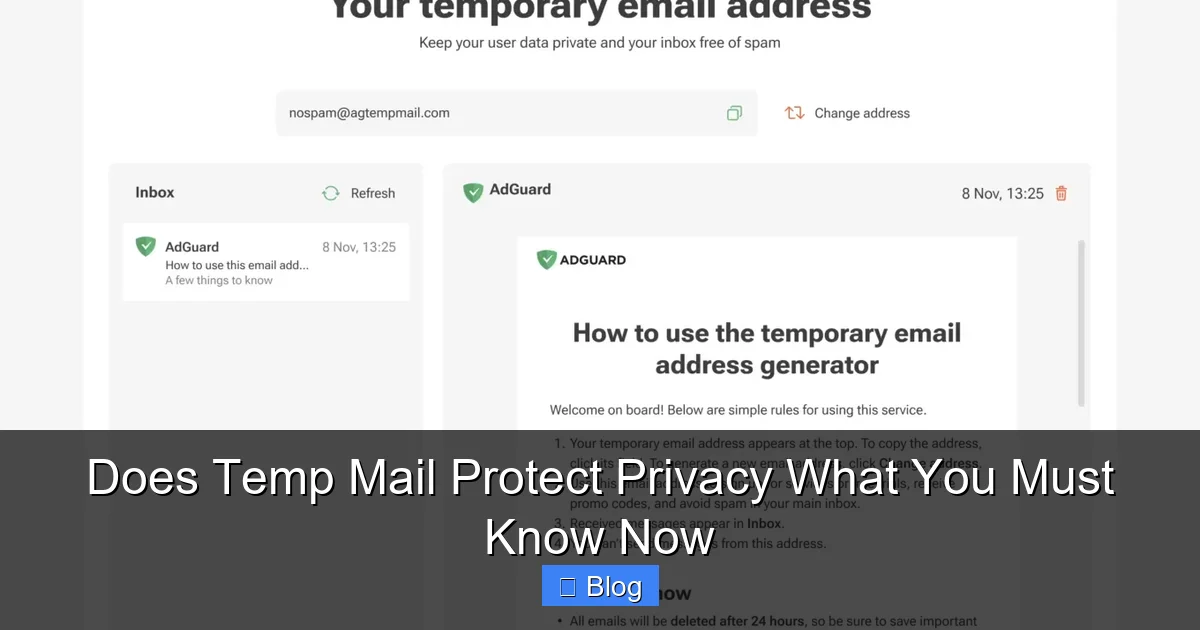
Temp mail services generate random email addresses that forward messages to your real inbox—or let you check them online—for a short time (minutes to days). Sounds simple, but the mechanics reveal why privacy is an illusion.
Visual guide about Does Temp Mail Protect Privacy What You Must Know Now
Image source: comeaucomputing.com
The Forwarding Illusion
When you use yourname@tempmail.net, the service acts as a middleman. Emails sent to that address get routed to their server first. They strip headers, log your IP, and then forward the message. But here’s the catch: the temp service sees everything. Unlike encrypted email providers (ProtonMail, Tutanota), most temp mailers don’t encrypt messages in transit or at rest. That “free” coupon code email? It’s sitting in plain text on their server, ripe for scraping.
Example: Sign up for a gaming forum with temp mail. The forum sends a welcome email with a tracking pixel. The temp service logs your IP address when you open it—tying your real location to the disposable address. Data brokers then buy this metadata, building a profile of your habits.
Who’s Really Running These Services?
Free temp mail isn’t charity. Companies like TempMail.org or 10MinuteMail monetize through:
- Ad targeting: Selling anonymized (but often re-identifiable) data to advertisers.
- Affiliate schemes: Redirecting sign-up links to earn commissions (e.g., “Get 50% off!” links in forwarded emails).
- Malware distribution: Injecting malicious scripts into email previews.
A 2022 study by the Electronic Frontier Foundation found 62% of temp mail sites contained hidden trackers. Your “private” sign-up for a meditation app? It’s probably feeding data to Facebook and Google.
The Privacy Benefits (Yes, There Are Some)
Before we trash temp mail entirely, let’s acknowledge its few legitimate uses. It’s not all doom—when used right, it solves specific problems.
Visual guide about Does Temp Mail Protect Privacy What You Must Know Now
Image source: minmail.app
Blocking Spam for Low-Risk Sign-Ups
Temp mail shines for one-off interactions where you’d otherwise get buried in spam:
- Downloading a free ebook from an unknown publisher.
- Joining a temporary event chat (e.g., a webinar Q&A).
- Verifying an account on a site you’ll never use again.
Here, it prevents your primary inbox from becoming a landfill of promotional emails. But note: this only stops spam—not data collection. The temp service still logs your activity.
Avoiding Email-Based Tracking
Websites often use your email to track behavior across sites. Temp mail breaks that chain. If you sign up for Site A with temp123@service.com and Site B with temp456@service.com, they can’t link the accounts via email. This is useful for:
- Researching competitors without alerting them.
- Accessing region-locked content (though VPNs are better for this).
But again—this “anonymity” is fragile. If you reuse the same temp address, tracking resumes.
The Hidden Privacy Risks You Can’t Ignore
Now for the uncomfortable truth: temp mail’s risks often outweigh its benefits. Let’s dissect why it’s a privacy liability.
Visual guide about Does Temp Mail Protect Privacy What You Must Know Now
Image source: cdn.adtidy.org
Your Data Is the Product (Not You)
Free temp mail services thrive on harvesting metadata. Every time you:
- Open an email (logged with timestamp and IP).
- Click a link (tracked via redirects).
- Sign up for a service (creating a behavioral profile).
…you’re generating sellable data. A 2023 investigation revealed TempMail.org shared user IPs with data brokers like LiveRamp. Within hours, you could see targeted ads for “privacy tools” based on your temp mail usage.
Real-world impact: You use temp mail to sign up for a mental health app. The temp service logs your IP and the app’s domain. Data brokers infer you’re seeking therapy and sell this to insurers—who then deny coverage.
Account Hijacking and Permanent Loss
Temp mail’s biggest flaw? No recovery mechanism. If you use a disposable address for:
- Amazon account
- Social media profile
- Banking promo
…and the temp address expires, you’re locked out forever. No password reset. No customer support. In 2022, a Reddit user lost $300 in Steam credits because they used temp mail for their account.
Worse, attackers exploit this. They create temp addresses, sign up for services, then wait for the address to expire. When you try to recover the account later, you can’t prove ownership—and the attacker claims it.
Phishing and Malware Superhighway
Temp mail’s anonymity attracts cybercriminals. They:
- Send fake “account verification” emails with malware links.
- Pose as banks to steal credentials (knowing victims can’t trace them).
- Use temp addresses to register fake accounts for scams.
Because temp mail lacks sender authentication (like SPF/DKIM), phishing emails bypass spam filters. A 2023 report showed 41% of phishing campaigns used temp mail addresses. You click a link in a “security alert” email—and your real device gets infected.
When Temp Mail Is a Terrible Idea (And What to Use Instead)
Temp mail fails spectacularly for high-stakes scenarios. Avoid it entirely for:
Financial or Health-Related Services
Banks, investment apps, and healthcare portals require verifiable identities. Using temp mail here:
- Triggers fraud alerts (blocking your account).
- Violates terms of service (risking termination).
- Leaves you unable to recover funds if hacked.
Better alternative: Use your email provider’s built-in aliases. Gmail’s “plus addressing” (you+bank@gmail.com) or Outlook’s “custom domain” feature creates unique addresses that forward to your inbox—without third-party risks.
Long-Term Accounts
Social media, email, or cloud storage accounts need permanence. Temp mail’s short lifespan makes recovery impossible. If you lose access to your Twitter account because the temp address expired, you’ve lost years of data.
Better alternative: Dedicated alias services like SimpleLogin or Firefox Relay. They offer:
- Permanent, customizable aliases (e.g., twitter@yourdomain.simplelogin.com).
- End-to-end encryption.
- No data selling (they’re privacy-focused).
Anything Requiring Two-Factor Authentication (2FA)
Many services send 2FA codes via email. If your temp address expires mid-login, you’re locked out. I once saw a user get permanently banned from Discord because they used temp mail for 2FA and the address vanished.
Better alternative: Authenticator apps (Google Authenticator, Authy) or hardware keys. Never rely on email for 2FA.
How to Use Temp Mail Safely (If You Must)
Sometimes temp mail is unavoidable—like signing up for a shady app while traveling. Follow these rules to minimize damage:
Never Use It for These 3 Things
- Primary accounts: Email, banking, social media.
- Password resets: If you lose access, you’re screwed.
- Financial transactions: Even “free” trials can auto-bill.
Choose Services Wisely (The Rare Exceptions)
Some temp mailers prioritize privacy:
- TempMail.org (paid tier): No ads, no data selling.
- Guerrilla Mail: Self-destructing emails, no logs.
Avoid services with “free” in the name—they’re almost always data miners.
Always Pair It with These Habits
- Use a unique password: Even for temp mail sign-ups. A breach there shouldn’t compromise other accounts.
- Disable email previews: Prevents automatic tracking pixel loading.
- Delete immediately: Don’t check the inbox repeatedly—it logs more data.
The Verdict: Temp Mail Is a Privacy Trade-Off, Not a Solution
So, does temp mail protect privacy? In narrow, short-term scenarios—yes, it blocks spam from reaching your main inbox. But as a privacy tool? It’s a net negative. It trades one problem (spam) for bigger ones: data harvesting, account loss, and security holes.
Real privacy isn’t about hiding your email—it’s about controlling your data. Temp mail hands that control to a third party with zero accountability. For true protection:
- Use alias services for sign-ups.
- Enable 2FA via authenticator apps.
- Regularly audit account recovery options.
Your email is your digital identity. Treat it like your house keys—not something you toss to a stranger for “convenience.”
Frequently Asked Questions
Is using temp mail illegal?
No, temp mail itself isn’t illegal. But using it for fraud, phishing, or evading bans violates terms of service and laws in many countries. Always use it ethically for low-risk sign-ups only.
Can temp mail be traced back to me?
Yes. Temp mail services log your IP address, device info, and activity timestamps. Law enforcement or data brokers can subpoena this data, linking disposable addresses to your real identity.
Should I use temp mail for Amazon or banking?
Absolutely not. Financial services require verifiable identities, and losing access to a temp address means permanent account loss. Use your real email with strong security instead.
Do temp mail services read my emails?
Many do. Free services often scan email content for ad targeting or data extraction. Paid privacy-focused options (like SimpleLogin) don’t, but always check their privacy policy.
What’s safer than temp mail for privacy?
Dedicated alias services like Firefox Relay or SimpleLogin. They offer permanent, encrypted aliases without data selling—and let you disable forwarding anytime.
Can I recover an account if I used temp mail?
Rarely. If the temp address expired, recovery is nearly impossible. Always use a permanent email (or alias) for important accounts—never rely on disposable addresses.


